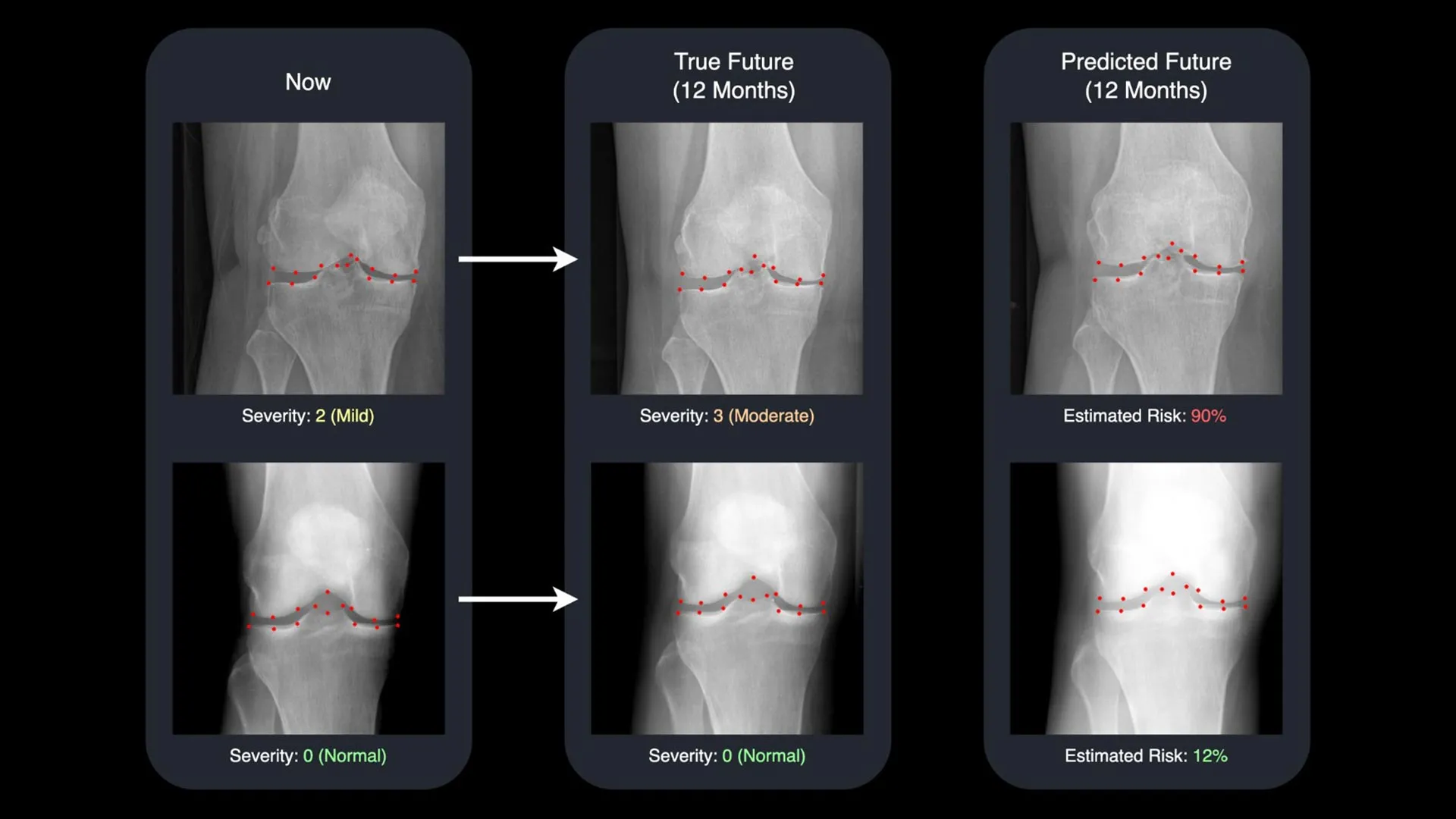
* A new AI system from the University of Surrey predicts future osteoarthritis progression from current knee X-rays. * The system generates realistic "future" X-ray images and personalized risk scores, offering visual insights. * Trained on nearly 50,000 X-rays, it operates with significantly greater speed and accuracy than previous tools. * This innovation aims to improve patient motivation, enable earlier clinical intervention, and could be adapted for other chronic diseases.
Revolutionizing Osteoarthritis Care with AI-Powered X-ray Predictions
A groundbreaking artificial intelligence system, developed by researchers at the University of Surrey, is poised to transform the landscape of osteoarthritis management. This innovative technology possesses the remarkable ability to forecast the likely appearance of a patient's knee X-ray up to one year into the future. Such a predictive capability could fundamentally reshape how millions grappling with osteoarthritis comprehend and actively manage their chronic condition.
The pioneering research, which garnered significant attention at the International Conference on Medical Image Computing and Computer Assisted Intervention (MICCAI 2025), introduces a sophisticated AI model. This model is not only adept at generating highly realistic "future" X-ray images but also provides a personalized risk assessment, estimating the trajectory of disease progression. When combined, these outputs furnish medical professionals and patients alike with an intuitive visual blueprint, illustrating how osteoarthritis might unfold over time.
This development, initially reported by Science Daily AI, marks a significant stride forward in leveraging artificial intelligence for proactive healthcare, moving beyond mere diagnosis to predictive insight.
The Challenge of Osteoarthritis: A Global Burden
Osteoarthritis, a debilitating degenerative joint disorder, represents a substantial global health challenge. Affecting more than half a billion individuals worldwide, it stands as the foremost cause of disability among the elderly population. The condition is characterized by the breakdown of cartilage in joints, leading to pain, stiffness, and reduced mobility. Current diagnostic and prognostic methods often rely on subjective assessments and static imaging, making it challenging to predict the precise pace and severity of disease progression for individual patients.
The lack of a clear, individualized roadmap for osteoarthritis progression often leaves patients feeling uncertain about their future joint health and the effectiveness of their treatment plans. Clinicians, too, face limitations in identifying high-risk patients early enough to implement truly proactive interventions. This gap highlights a critical need for more advanced tools that can offer clearer, more actionable insights into the disease's likely course.
Introducing Surrey's Predictive AI System
The AI system engineered by the University of Surrey team represents a major leap in addressing these challenges. Its core functionality revolves around two key outputs:
- Visual Prognosis: Generating Future X-rays: Unlike traditional AI tools that might offer a numerical risk score, this system creates a tangible, visual representation of a patient's knee X-ray as it might appear in twelve months. This side-by-side comparison of current and predicted future images provides an unprecedented level of clarity.
- Personalized Risk Assessment: Alongside the visual prediction, the AI provides a personalized risk score. This score quantifies the estimated likelihood and extent of disease progression, offering a data-driven complement to the visual forecast.
This dual approach ensures that both qualitative visual evidence and quantitative data are available, empowering a more holistic understanding of a patient's condition and future outlook.
Technical Prowess: A Deeper Dive into the AI
The robustness and accuracy of the Surrey system stem from its extensive training and sophisticated architecture. The AI was meticulously trained on a massive dataset comprising nearly 50,000 knee X-rays collected from approximately 5,000 patients. This makes it one of the most comprehensive datasets of its kind, enabling the AI to learn intricate patterns and subtle indicators of disease progression with high fidelity.
At the technological heart of this innovative system lies an advanced generative model known as a diffusion model. Diffusion models are a class of AI that excels at generating high-quality, realistic images by progressively refining random noise into coherent data. In this application, the diffusion model takes a current X-ray image and, based on its learned understanding of osteoarthritis progression, generates a plausible "future" version of that X-ray.
Beyond image generation, the system also identifies 16 specific key points within the joint, meticulously tracking these areas for potential changes. This feature significantly enhances the transparency of the AI's predictions, allowing clinicians to see precisely which parts of the knee the algorithm is monitoring. This level of detail helps build confidence and understanding in the AI's prognostic capabilities, fostering greater trust among medical professionals.
Furthermore, the researchers highlight that their system operates with remarkable efficiency, predicting disease progression approximately nine times faster than comparable AI tools. This combination of speed, precision, and transparency is crucial for its potential integration into busy clinical environments, where rapid and reliable insights are paramount. For more details, see generative AI.
Transforming Patient-Doctor Engagement
One of the most profound impacts of this AI system lies in its potential to revolutionize the dialogue between patients and their healthcare providers. The ability to visually demonstrate future progression offers a powerful motivational tool, transcending the limitations of abstract numerical predictions. For more details, see generative AI.
"We're used to medical AI tools that give a number or a prediction, but not much explanation. Our system not only predicts the likelihood of your knee getting worse — it actually shows you a realistic image of what that future knee could look like. Seeing the two X-rays side by side — one from today and one for next year — is a powerful motivator. It helps doctors act sooner and gives patients a clearer picture of why sticking to their treatment plan or making lifestyle changes really matters. We think this can be a turning point in how we communicate risk and improve osteoarthritic knee care and other related conditions." For more details, see generative AI.
Butler's insights underscore a critical aspect of patient care: effective communication. When patients can visually grasp the potential consequences of inaction or the benefits of adherence to treatment, their engagement and motivation to manage their condition significantly increase. This visual clarity empowers individuals to make more informed lifestyle choices and adhere more diligently to prescribed therapies, potentially slowing progression and improving long-term outcomes.
Enhanced Transparency and Clinical Confidence
For clinicians, the system offers a new level of support in making timely and personalized treatment decisions. The ability to see not just a prediction, but *how* that prediction manifests visually, provides invaluable context.
"Earlier AI systems could estimate the risk of osteoarthritis progression, but they were often slow, opaque and limited to numbers rather than clear images. Our approach takes a big step forward by generating realistic future X-rays quickly and by pinpointing the areas of the joint most likely to change. That extra visibility helps clinicians identify high-risk patients sooner and personalize their care in ways that were not previously practical."
Professor Carneiro's comments highlight the dual benefits of speed and clarity. The quick generation of detailed future X-rays, combined with the identification of specific "hot spots" of change, allows doctors to pinpoint high-risk patients more effectively. This enables the personalization of care plans, from recommending specific exercises and physical therapy to considering early interventions or medication adjustments. Such proactive management, informed by precise visual data, holds the potential to significantly improve patient prognoses and quality of life.
Broader Horizons: AI's Potential Beyond Knee Health
The researchers at the University of Surrey envision a future where this predictive AI framework extends far beyond osteoarthritis of the knee. The underlying methodology, particularly the use of generative diffusion models for forecasting morphological changes, is highly adaptable. The team believes their approach could be tailored to predict the progression of a wide array of other chronic diseases that manifest visible changes over time.
For instance, similar AI tools might one day be capable of predicting the extent of lung damage in smokers, providing a stark visual warning that could motivate cessation. Another potential application lies in tracking the progression of heart disease, offering visual insights into arterial changes or myocardial damage. This adaptability opens up exciting avenues for applying this predictive paradigm across various medical specialties, delivering the same kind of visual insights and early warnings that this system offers for osteoarthritis.
The Road Ahead: Integrating AI into Healthcare
The next crucial phase for this technology involves transitioning from a research breakthrough to a clinically integrated tool. The Surrey team is actively seeking collaborations with hospitals, healthcare providers, and industry partners to facilitate the adoption and implementation of their system into everyday healthcare practices. This process will involve rigorous clinical validation, regulatory approvals, and careful integration into existing medical workflows.
The potential benefits of widespread adoption are immense. By enabling earlier identification of individuals at high risk of rapid disease progression, the system could facilitate timely interventions that might slow or even prevent severe joint damage. This shift towards proactive, preventative care, driven by intelligent predictive analytics, represents a significant step forward in modern medicine.
Conclusion: A New Era for Proactive Healthcare
The AI system developed by the University of Surrey represents a compelling demonstration of artificial intelligence's transformative power in healthcare. By turning static X-rays into dynamic "time machines" that forecast future disease progression, it provides an unprecedented visual roadmap for osteoarthritis.
This article is an independent analysis and commentary based on publicly available information.
Comments (0)