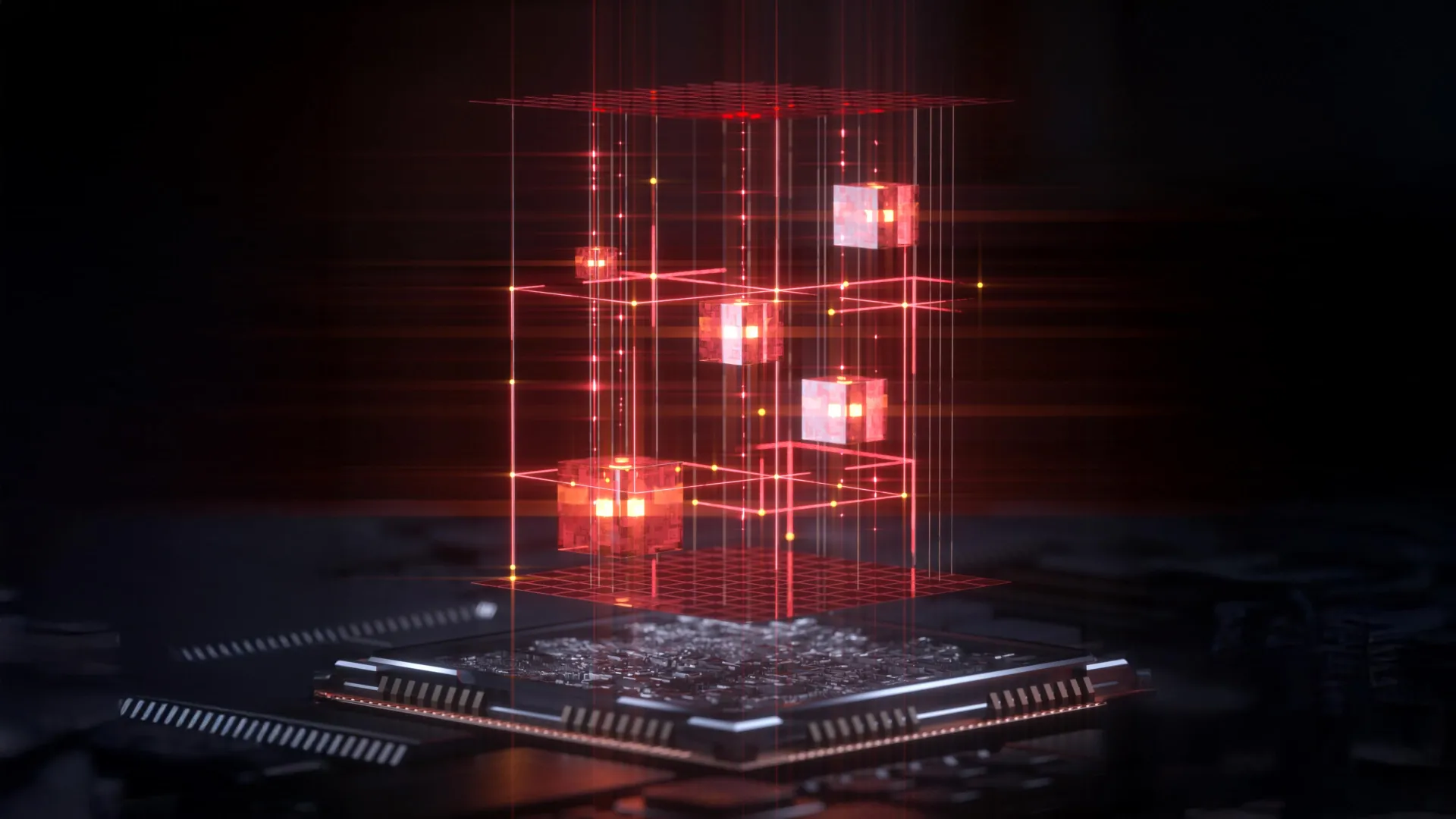
- Researchers developed a novel optical computing method for AI, performing tensor operations at the speed of light.
- This "single-shot" approach bypasses traditional digital hardware limitations, offering vastly improved speed and energy efficiency.
- Information is encoded into light waves, which then physically interact to perform complex mathematical calculations simultaneously.
- The technology aims to integrate into photonic chips within 3-5 years, potentially revolutionizing AI processing across various fields.
The relentless pace of innovation in artificial intelligence continues to push the boundaries of computational power. At the heart of many advanced AI systems, from sophisticated image recognition to nuanced natural language understanding, lies a complex mathematical framework known as tensor operations. These multi-dimensional calculations are foundational to deep learning algorithms, yet they also represent a significant bottleneck for conventional digital hardware, demanding ever-increasing speed, energy, and scalability.
In a development that promises to reshape the landscape of AI computing, an international research team, spearheaded by Dr. Yufeng Zhang from Aalto University's Photonics Group, has unveiled a fundamentally new approach. Their method harnesses the inherent properties of light to execute these intricate tensor calculations with unprecedented efficiency and speed, effectively performing "single-shot tensor computing" at the speed of light. This breakthrough, detailed in a study published in Nature Photonics, represents a significant leap forward in the quest for more powerful and sustainable AI.
The Computational Demands of Modern AI
Artificial intelligence, particularly in the realm of deep learning, relies heavily on processing vast datasets to identify patterns, make predictions, and understand complex information. Central to these processes are tensor operations – advanced mathematical computations that manipulate multi-dimensional arrays of numbers. Unlike the simple arithmetic encountered in everyday life, tensor operations involve simultaneous transformations across multiple data points, akin to intricately manipulating a multi-dimensional puzzle where layers are rotated, sliced, and rearranged all at once.
For AI applications such as processing high-resolution images, interpreting human language, or powering autonomous systems, these operations are indispensable. They enable neural networks to learn from data, recognize features, and make informed decisions. However, as AI models grow in complexity and the sheer volume of data continues to expand exponentially, the computational burden on existing hardware, primarily Graphics Processing Units (GPUs), becomes increasingly severe. While GPUs have been instrumental in accelerating AI development, their digital, sequential processing nature inherently limits their speed, consumes substantial energy, and presents scalability challenges for future AI advancements.
A Luminous Solution: Single-Shot Tensor Computing
Addressing these critical limitations, the team led by Dr. Zhang has pioneered a novel optical computing technique. Their innovative method enables the completion of complex tensor computations through a single, instantaneous passage of light through an optical system. This "single-shot" approach stands in stark contrast to the iterative, sequential calculations performed by traditional electronic circuits, offering a paradigm shift in how AI tasks can be processed.
"Our technique replicates the same types of operations that contemporary GPUs manage, such as convolutional layers and attention mechanisms, but executes them all at the velocity of light," explained Dr. Zhang. "Instead of relying on electronic pathways, we leverage the fundamental physical characteristics of light to carry out numerous computations concurrently." This simultaneous processing capability is what grants the optical system its remarkable speed and efficiency, bypassing the inherent delays associated with electron movement in digital circuits.
Encoding Information for Light-Speed Calculations
The ingenuity of this system lies in its ability to translate digital information into the physical attributes of light. Researchers achieved this by embedding numerical data into both the amplitude (brightness) and phase (position in its wave cycle) of light waves. Essentially, numerical data is transformed into tangible variations within the optical field. As these specially encoded light waves propagate and interact within the optical system, they naturally perform the required mathematical procedures, such as matrix and tensor multiplication, which are the bedrock of deep learning algorithms.
To further enhance the system's capabilities, the researchers extended their technique to work with multiple wavelengths of light. This multi-wavelength approach allows for the handling of even more complex, higher-order tensor operations, significantly expanding the range and sophistication of AI tasks that can be performed optically. This parallel processing across different light channels is a key enabler for the system's efficiency.
Dr. Zhang offered a vivid analogy to illustrate the efficiency of their method: "Imagine you are a customs inspector tasked with examining every package using various machines, each performing a different function, before sorting them into their correct destinations. Typically, you would process each package individually, moving it through the sequence of machines. Our optical computing method, however, effectively merges all packages and all inspection machines into one unified process. We establish multiple 'optical connections' that link each input parcel to its correct output destination. With just one operation, a single pass of light, all inspections and sorting occur instantly and in parallel." This analogy powerfully conveys the simultaneous, non-sequential nature of the optical computation. For more details, see energy efficiency.
The Advantages of Passive Optical Computation
One of the most compelling benefits of this light-based computational method is its minimal requirement for active intervention. Unlike electronic systems that necessitate constant active control and electronic switching to guide data flow and execute operations, the necessary calculations in this optical system unfold autonomously as the light travels. This passive nature significantly reduces the complexity of the system, lowers potential points of failure, and drastically cuts down on energy consumption.
The inherent efficiency and design simplicity make this approach highly versatile. "This methodology can be implemented across virtually any optical platform," stated Professor Zhipei Sun, who leads Aalto University's Photonics Group. "Looking ahead, our objective is to integrate this computational framework directly onto photonic chips. This will enable light-based processors to tackle complex AI tasks with remarkably low power consumption, paving the way for a new era of energy-efficient AI."
Future Integration and Impact on AI Development
The vision for this optical computing breakthrough extends beyond the laboratory. Dr. Zhang is optimistic about the practical application of this technology, estimating that the method could be adapted for integration into existing hardware and platforms utilized by major technology companies within a timeframe of three to five years. This rapid potential for adoption underscores the transformative impact this research could have on the industry.
The integration of optical computing into AI systems promises to unlock new levels of performance and efficiency. By providing a fundamental shift from electron-based to photon-based computation, it could significantly accelerate complex AI tasks across a multitude of fields. From enabling faster training of deep learning models to facilitating real-time inference in edge devices, the implications are far-reaching. Industries such as healthcare, finance, automotive, and telecommunications, all heavily reliant on AI, stand to benefit immensely from processors capable of handling massive data streams with unparalleled speed and minimal energy expenditure.
The development could also foster the creation of entirely new AI applications that are currently computationally infeasible. Imagine AI systems capable of processing vast sensory inputs in real-time with virtually no latency, or training models on datasets orders of magnitude larger than what is currently practical. The energy savings alone could have a profound environmental impact, reducing the carbon footprint of increasingly energy-intensive AI data centers.
Conclusion
The research from Aalto University, as reported by Science Daily AI, marks a pivotal moment in the evolution of AI hardware. By harnessing the fundamental properties of light to perform tensor operations, Dr. Yufeng Zhang and his team have introduced a "single-shot" optical computing method that offers a compelling alternative to traditional electronic systems. With its promise of light-speed processing, drastically reduced energy consumption, and inherent scalability, this innovation is poised to redefine the capabilities of artificial intelligence.
As the world continues to embrace AI across every sector, the demand for more efficient, powerful, and sustainable computing solutions will only grow. The advent of optical AI computing, particularly its potential integration into compact photonic chips, represents not just an incremental improvement, but a fundamental paradigm shift that could propel AI into an era of unprecedented capability and accessibility. The future of AI, it seems, is brighter than ever.
❓ Frequently Asked Questions
Q: What are tensor operations and why are they important for AI?A: Tensor operations are advanced mathematical calculations involving multi-dimensional arrays of numbers. They are fundamental to modern AI systems, particularly deep learning, as they enable neural networks to process complex data for tasks like image recognition, natural language processing, and data analysis.
Q: How does optical computing differ from traditional GPU-based AI computing?A: Traditional GPU-based computing relies on electronic circuits and sequential processing of data. Optical computing, in contrast, uses the physical properties of light waves to encode information and perform calculations simultaneously. This allows for significantly faster processing speeds (at the speed of light) and much lower energy consumption compared to electronic systems.
Q: What does "single-shot tensor computing" mean?A: "Single-shot tensor computing" refers to the ability of the optical system to complete complex tensor calculations in a single, instantaneous pass of light through the system. Unlike digital systems that break down tasks into sequential steps, this method performs all necessary operations concurrently, offering a massive boost in efficiency and speed.
Q: When can we expect this technology to be integrated into commercial AI systems?A: Dr. Yufeng Zhang estimates that the optical computing method could be adapted for integration into existing hardware and platforms used by major technology companies within 3 to 5 years. The long-term goal is to integrate this computational framework directly onto photonic chips, enabling highly efficient, light-based processors for AI.
This article is an independent analysis and commentary based on publicly available information.
Comments (0)