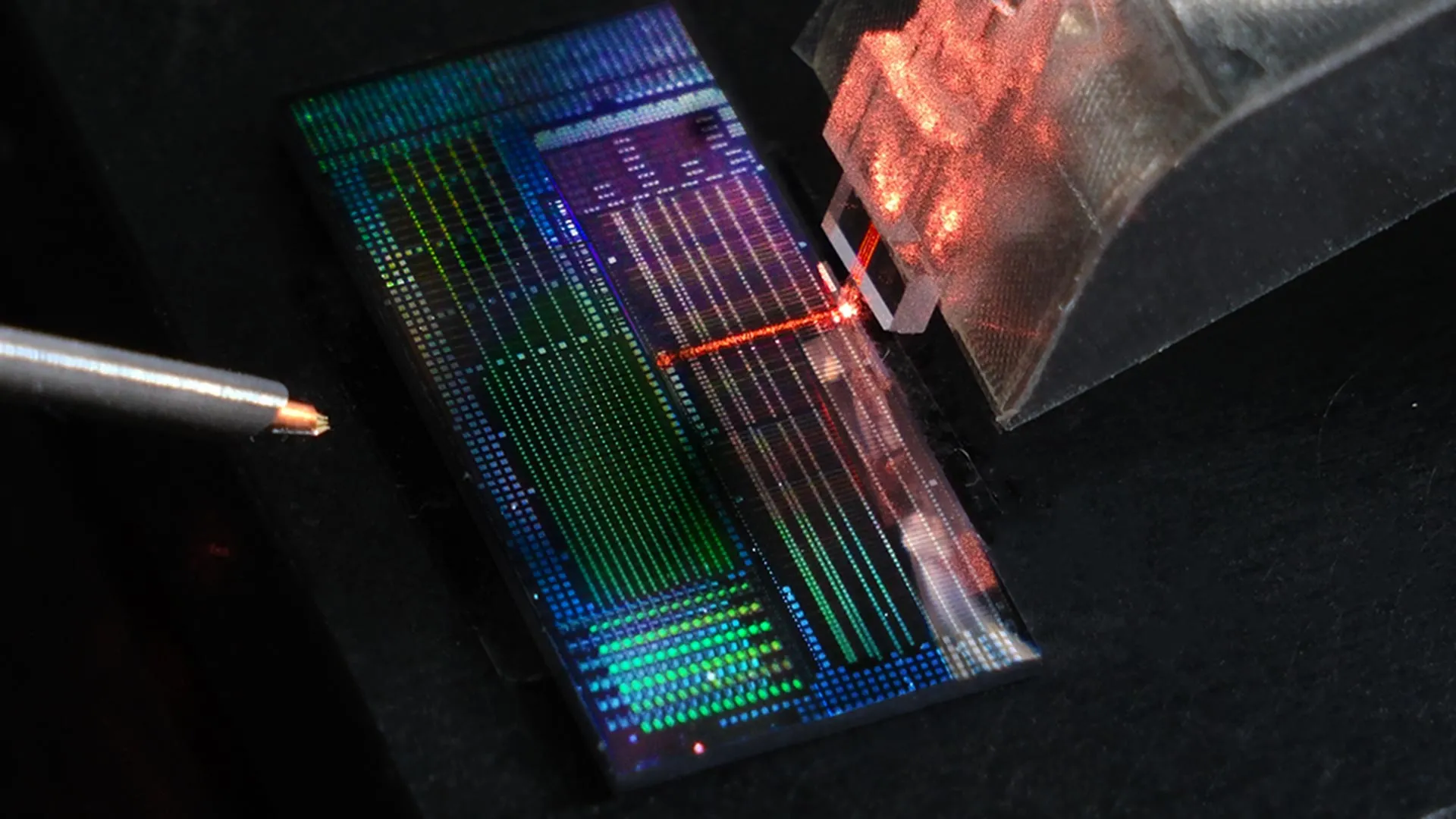
- Researchers developed an optical phase modulator chip, nearly 100 times thinner than a human hair, for precise laser control in quantum computers.
- The chip is manufactured using scalable CMOS processes, similar to standard microchips, making mass production feasible and cost-effective.
- It significantly reduces power consumption (by 80x) and heat generation compared to current devices, allowing for denser integration of optical channels.
- This advancement is crucial for scaling up quantum computing systems that rely on trapped ions or atoms, and has implications for quantum sensing and networking.
Pioneering a New Era for Quantum Computing with Microscopic Modulators
In a pivotal development for the field of quantum technology, researchers have engineered a novel device that could fundamentally reshape the future of quantum computing. This tiny optical phase modulator chip, remarkably almost 100 times slimmer than a human hair, represents a significant stride towards overcoming some of the most formidable challenges in scaling quantum systems. Published in the esteemed journal *Nature Communications*, this work introduces a mechanism for precisely manipulating laser light, an indispensable capability for the complex operations required by future quantum computers that may house thousands or even millions of qubits – the foundational units of quantum information.
The innovation, reported by Science Daily AI, not only miniaturizes a critical component but also addresses the pressing need for scalable manufacturing in quantum hardware. This dual achievement positions the technology as a potential game-changer for transitioning quantum research from specialized laboratories to widespread practical applications.
The Core Innovation: Precision Light Control for Qubits
At the heart of quantum computing lies the ability to meticulously control individual qubits. Many leading quantum computing architectures, particularly those utilizing trapped ions or neutral atoms, depend on highly tuned laser beams to interact with these atomic qubits, effectively issuing instructions for quantum calculations. The precision required for these laser adjustments is astounding, often demanding accuracy within billionths of a percent.
The newly developed optical phase modulator chip excels in this precise laser manipulation. It operates by harnessing microwave-frequency vibrations that oscillate billions of times per second, enabling the chip to control laser light with exceptional accuracy. This capability allows for the generation of new laser frequencies that are both stable and efficient – a critical requirement not only for advanced quantum computing but also for nascent fields such like quantum sensing and quantum networking.
Jake Freedman, an incoming PhD student in the Department of Electrical, Computer and Energy Engineering and a lead researcher on the project, underscored the importance of this functionality. "Creating new copies of a laser with very exact differences in frequency is one of the most important tools for working with atom- and ion-based quantum computers," Freedman stated. "But to do that at scale, you need technology that can efficiently generate those new frequencies."
Overcoming Current Limitations in Quantum Hardware
Presently, achieving these precise laser frequency shifts typically involves bulky, table-top devices that consume substantial microwave power. While adequate for small-scale experimental setups, these systems are fundamentally impractical for the massive number of optical channels that will be necessary in future, larger quantum computers. The physical footprint and energy demands of current solutions present a significant bottleneck to scaling.
Matt Eichenfield, professor and Karl Gustafson Endowed Chair in Quantum Engineering, highlighted this challenge. "You're not going to build a quantum computer with 100,000 bulk electro-optic modulators sitting in a warehouse full of optical tables," Eichenfield remarked. He emphasized the necessity for "much more scalable ways to manufacture them that don't have to be hand-assembled and with long optical paths." The new chip directly addresses these limitations by offering a compact, efficient, and manufacturable alternative.
Scalability Through Standard Manufacturing Processes
One of the most profound aspects of this research lies in its manufacturing approach. Rather than relying on bespoke laboratory equipment and intricate manual assembly, the researchers leveraged scalable fabrication methods akin to those used to produce the microprocessors found in virtually all modern electronics, from smartphones to electric vehicles. This strategic choice is pivotal for the practical realization of large-scale quantum computers.
Leveraging CMOS Fabrication for Quantum Devices
The device was entirely manufactured in a standard fabrication facility, commonly known as a "fab," the same environment where advanced microelectronics are produced using Complementary Metal-Oxide-Semiconductor (CMOS) technology. CMOS fabrication is renowned for its ability to create billions of identical transistors on a single chip, making it the most scalable manufacturing technology humanity has ever developed.
Eichenfield elaborated on the significance of this approach: "Every microelectronic chip in every cell phone or computer has billions of essentially identical transistors on it. So, by using CMOS fabrication, in the future, we can produce thousands or even millions of identical versions of our photonic devices, which is exactly what quantum computing will need." This move from custom-built components to standardized, high-volume production is a critical step towards industrializing quantum hardware.
From Lab Bench to Mass Production
The ability to mass-produce these optical phase modulators at a low cost is a transformative factor. Traditional quantum experiments often rely on expensive, hand-assembled optical components that are difficult to replicate consistently. By adopting CMOS fabrication, the team has effectively redesigned modulator technologies that were once bulky, costly, and power-intensive, making them smaller, more efficient, and far easier to integrate into complex systems. This paradigm shift accelerates the transition of quantum technologies from research prototypes to commercially viable products.
Energy Efficiency and Denser Integration
Beyond its diminutive size and scalable manufacturing, the new optical phase modulator also boasts significant improvements in energy efficiency. It generates laser frequency shifts through highly efficient phase modulation while consuming approximately 80 times less microwave power than many commercially available modulators. This reduction in power consumption has a cascading benefit: less power means less heat generated.
Reducing Power Consumption and Heat
The issue of heat dissipation is a major concern in high-density electronic and photonic systems. Excessive heat can degrade performance, reduce reliability, and limit the proximity of components. By drastically cutting down on microwave power requirements, the new chip allows for a much denser packing of optical channels. This means more modulators can be integrated closely together, potentially even onto a single chip, without overheating. This compact integration is essential for controlling the vast number of qubits envisioned for future quantum computers.
Enabling Denser Qubit Architectures
The combined advantages of small size, low power consumption, and reduced heat output transform this chip into a highly scalable system. It can efficiently coordinate the precise interactions that atoms require to perform quantum calculations, making it feasible to build quantum processors with unprecedented numbers of qubits. This capability is vital for moving beyond current small-scale quantum demonstrations to powerful, fault-tolerant quantum machines.
Broadening Quantum Applications and Future Outlook
The implications of this technological leap extend beyond just quantum computing. The precise control over laser beams offered by this new device is also a key enabler for emerging quantum fields such as quantum sensing, which uses quantum phenomena to achieve ultra-high precision measurements, and quantum networking, which aims to establish secure communication channels based on quantum mechanics.
The Path to Integrated Photonic Circuits
The research team, which included collaborators from Sandia National Laboratories such as co-senior author Nils Otterstrom, is now focused on developing fully integrated photonic circuits. These circuits would combine frequency generation, filtering, and pulse shaping—all critical optical functions—onto a single chip. This ambitious goal represents a significant step towards creating a complete, operational quantum photonic platform.
Otterstrom likened this progression to a historical technological shift: "We're helping to push optics into its own 'transistor revolution,' moving away from the optical equivalent of vacuum tubes and towards scalable integrated photonic technologies." This analogy underscores the transformative potential of integrating complex optical functionalities onto microchips, mirroring the revolution brought about by transistors in electronics.
Future Collaborations and Funding
Looking ahead, the team plans to partner with leading quantum computing companies. These collaborations will facilitate the rigorous testing of these advanced chips within operational trapped-ion and trapped-neutral-atom quantum computers, validating their performance in real-world quantum environments.
Freedman expressed optimism about the project's trajectory, stating, "This device is one of the final pieces of the puzzle. We're getting close to a truly scalable photonic platform capable of controlling very large numbers of qubits." The project has garnered significant support from the U.S. Department of Energy through the Quantum Systems Accelerator program, a National Quantum Initiative Science Research Center, highlighting its strategic importance to national quantum research efforts.
Conclusion: A Leap Towards Practical Quantum Systems
The development of this ultra-thin, energy-efficient, and mass-producible optical phase modulator chip marks a monumental achievement in quantum engineering. By addressing critical challenges in scalability, power consumption, and manufacturing, researchers have brought the vision of large-scale, practical quantum computers significantly closer to reality. This innovation not only promises to accelerate advancements in quantum computing but also lays foundational groundwork for the broader landscape of quantum technologies, heralding a new era of scientific discovery and technological innovation.
Related Resources:
❓ Frequently Asked Questions
Q1: What is an optical phase modulator, and why is it important for quantum computing?A1: An optical phase modulator is a device that precisely controls the phase of a laser beam, which in turn can be used to generate new laser frequencies. In quantum computing, particularly with trapped ion or neutral atom systems, highly accurate laser beams are essential to interact with and control individual qubits, the fundamental units of quantum information. This precise control allows for the execution of quantum calculations.
Q2: How does this new chip improve upon existing technologies for quantum computing?A2: The new chip offers several key improvements: it's nearly 100 times thinner than a human hair, making it incredibly compact; it consumes about 80 times less microwave power, leading to significantly less heat generation; and crucially, it's manufactured using scalable CMOS fabrication methods, similar to those for standard microprocessors. These factors enable mass production, lower costs, and denser integration of optical channels, which are vital for scaling up quantum computers.
Q3: What does "CMOS fabrication" mean in the context of this quantum chip?A3: CMOS (Complementary Metal-Oxide-Semiconductor) fabrication refers to the standard manufacturing process used to produce virtually all modern microelectronic chips, such as those in computers and smartphones. By using CMOS fabrication for this quantum optical device, researchers can leverage an established, highly scalable, and cost-effective method to produce thousands or even millions of identical chips, a capability essential for building large-scale quantum systems.
Q4: Beyond quantum computing, what other fields could benefit from this technology?A4: The precise laser control offered by this optical phase modulator has significant implications for other emerging quantum technologies. These include quantum sensing, which uses quantum phenomena for ultra-sensitive measurements in areas like medical imaging or navigation, and quantum networking, which aims to create secure communication systems based on the principles of quantum mechanics.
This article is an independent analysis and commentary based on publicly available information.
Comments (0)