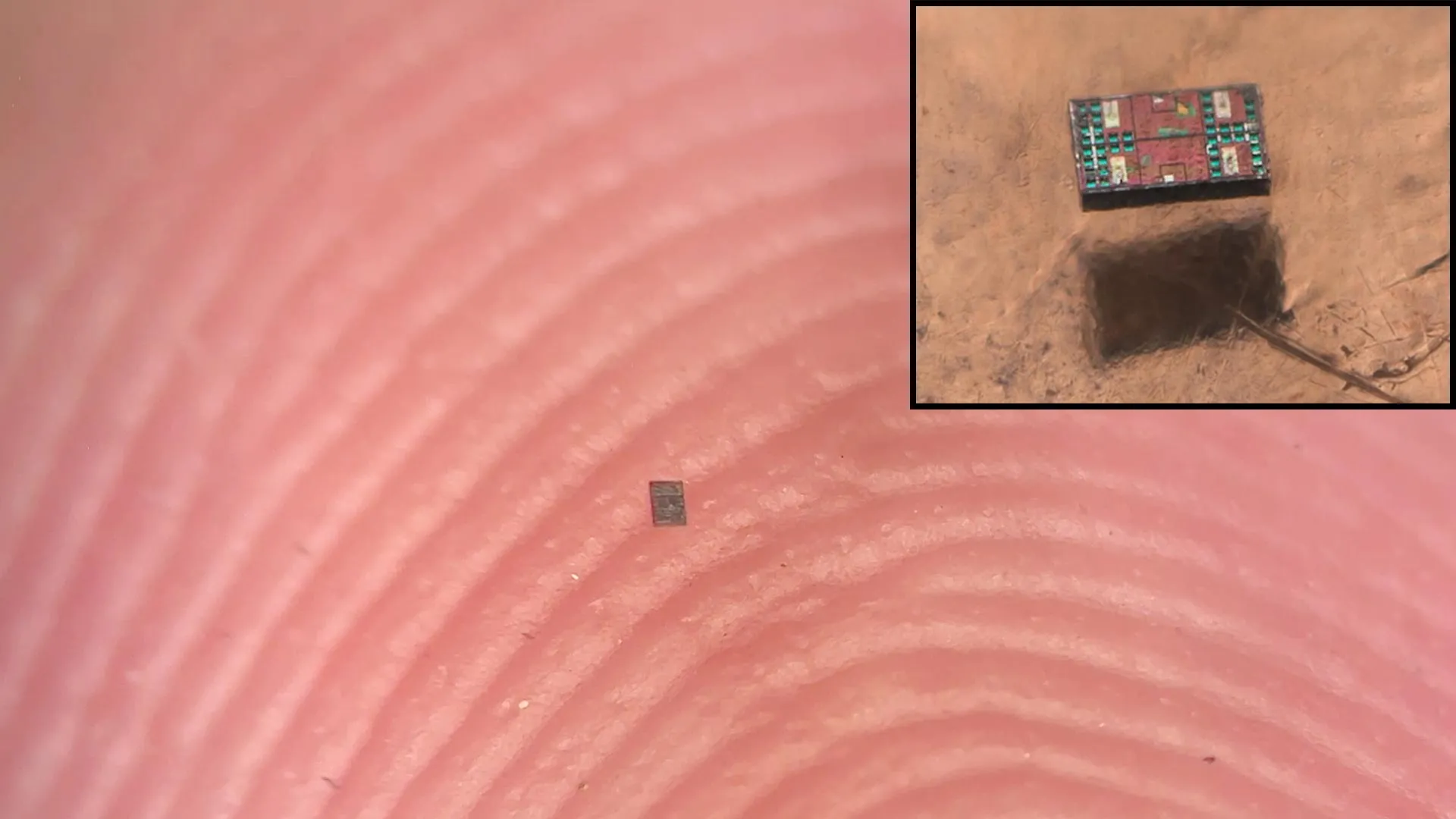
* Researchers from Penn Engineering and the University of Michigan have developed the smallest fully programmable autonomous robots. * These robots are smaller than a grain of salt, can swim, sense, and respond independently, operating for months on light power. * They overcome microscopic physics challenges with a novel electrical field propulsion system and ultra-low-power computing. * Potential applications include monitoring individual cells, assisting in advanced manufacturing, and revolutionizing various scientific fields.
In a significant leap forward for robotics, scientists from the University of Pennsylvania and the University of Michigan have engineered a class of autonomous robots so minuscule they are smaller than a grain of salt. These groundbreaking devices represent the smallest fully programmable, independent robots ever created, possessing the remarkable ability to navigate liquids, perceive their surroundings, make decisions, and function for extended periods—all while costing approximately one penny each to produce.
This innovation, initially reported by Science Daily AI, marks a pivotal moment in the field of micro-robotics. Unlike previous microscopic machines that relied on external tethers, magnetic fields, or manual control, these new entities operate with true independence, powered entirely by ambient light and equipped with microscopic onboard computers.
A Paradigm Shift in Micro-Robotics
Measuring roughly 200 by 300 by 50 micrometers, these tiny machines are practically invisible without magnification. Their scale is comparable to many living microorganisms, suggesting a future where robots could seamlessly integrate into biological systems or assist in the assembly of intricate devices at an atomic level. The implications for medicine, advanced manufacturing, and fundamental scientific research are vast and transformative.
The research, detailed in prestigious journals like Science Robotics and the Proceedings of the National Academy of Sciences (PNAS), highlights a critical distinction: these are the first truly autonomous and programmable robots at such an unprecedented small scale. This breakthrough fundamentally redefines what is possible in the realm of miniature robotics.
Breaking the Size Barrier for Autonomy
"We've made autonomous robots 10,000 times smaller," stated Marc Miskin, an Assistant Professor in Electrical and Systems Engineering at Penn Engineering and a senior author on the papers, emphasizing the new scale unlocked for programmable robots. For decades, while electronics have consistently shrunk, robotics has struggled to achieve true independence at sub-millimeter dimensions. Miskin notes that building robots that operate independently at sizes below one millimeter has remained an incredibly difficult, unsolved challenge for approximately 40 years.
Navigating the Microscopic World: Overcoming Physics
The challenges of designing robots at such a tiny scale are profound. At everyday dimensions, forces like gravity and inertia, which depend on an object's volume, dictate motion. However, in the microscopic world, surface-related forces dominate. Drag and viscosity become overwhelming, fundamentally altering how movement occurs. As Miskin vividly explains, "If you're small enough, pushing on water is like pushing through tar."
This dramatic shift in physics renders conventional robotic designs ineffective. Traditional tiny arms or legs are not only prone to breakage but are also exceedingly difficult to manufacture with the required precision. To circumvent these limitations, the research team pioneered an entirely novel locomotion method that harmonizes with the physics of the microscopic realm rather than attempting to counteract it.
A Novel Propulsion System: Electrokinetic Swimming
Unlike larger swimmers, such as fish, which propel themselves by pushing water backward in accordance with Newton's Third Law, these microscopic robots employ a distinct approach. Instead of relying on moving mechanical parts, they generate a localized electrical field. This field gently pushes charged particles, or ions, within the surrounding liquid. As these ions move, they drag nearby water molecules along, effectively creating a current that propels the robot. "It's as if the robot is in a moving river," Miskin describes, "but the robot is also causing the river to move."
By precisely adjusting this electrical field, the robots can manipulate their direction, follow intricate pathways, and even coordinate their movements in groups, mimicking the synchronized behavior of a school of fish. They can achieve speeds of up to one body length per second. This innovative swimming mechanism, utilizing electrodes with no moving components, contributes significantly to the robots' remarkable durability. They can be repeatedly transferred between samples without sustaining damage and, powered by light from an LED, can continue swimming for months.
The Intelligence Within: Microscopic Computing
True autonomy extends beyond mere movement; a robot must also possess the capability to sense its environment, process information, make decisions, and power itself. Integrating all these complex components onto a chip that is only a fraction of a millimeter across presented an immense engineering hurdle. This critical aspect of the project was spearheaded by David Blaauw's team at the University of Michigan.
Miniaturizing the Brain: Michigan's Expertise
Blaauw's laboratory is renowned for its achievements in creating the world's smallest computers. A fortuitous meeting between Blaauw and Miskin at a Defense Advanced Research Projects Agency (DARPA) presentation five years prior revealed the synergistic potential of their respective technologies. "We saw that Penn Engineering's propulsion system and our tiny electronic computers were just made for each other," Blaauw recounted. Despite this clear compatibility, transforming the concept into a functional, autonomous robot demanded five years of dedicated development.
One of the most formidable challenges was power management. "The key challenge for the electronics," Blaauw explained, "is that the solar panels are tiny and produce only 75 nanowatts of power. That is over 100,000 times less power than what a smart watch consumes." To overcome this, the team engineered specialized circuits capable of operating at extremely low voltages, thereby reducing power consumption by more than a thousandfold.
Space was another severe constraint. The microscopic solar panels occupy the majority of the robot's surface, leaving minimal room for computational hardware. To address this, the researchers completely redesigned the robot's software architecture. "We had to totally rethink the computer program instructions," Blaauw elaborated, "condensing what conventionally would require many instructions for propulsion control into a single, special instruction to shrink the program's length to fit in the robot's tiny memory space."
These collective advancements culminated in what the researchers believe to be the first sub-millimeter robot capable of genuine decision-making. To their knowledge, no prior endeavor has successfully integrated a complete computer—comprising a processor, memory, and sensors—into a robot of this diminutive size. This achievement empowers the robots to sense their environment and respond autonomously.
Sensing the Microscopic World
The robots are equipped with electronic temperature sensors capable of detecting minute changes, as small as one-third of a degree Celsius. This highly sensitive capability allows them to execute programmed behaviors, such as migrating towards warmer regions, or to report precise temperature values. Such data can serve as crucial indicators of cellular activity, offering an unprecedented method for monitoring individual cells directly within their environment.
Future Frontiers: Applications and Impact
The development of these microscopic autonomous robots opens up a vast array of potential applications across numerous sectors, promising to revolutionize how we interact with the smallest scales of our world.
Medical and Biomedical Google AI's 2025: Breakthroughs in Reasoning and Science">Breakthroughs
In the medical field, these tiny programmable robots could lead to significant advancements. Their ability to operate at the cellular level makes them ideal candidates for targeted drug delivery, where they could transport therapeutic agents directly to diseased cells, minimizing side effects on healthy tissues. They could also function as miniature diagnostic tools, swimming through bodily fluids to detect early signs of disease, monitor cellular health, or even assist in intricate micro-surgeries. Imagine fleets of these robots exploring the human body, providing real-time data and performing precise interventions.
Advanced Manufacturing and Material Science
For advanced manufacturing, these robots offer unprecedented capabilities. They could be deployed to assemble microscopic components with extreme precision, fabricate complex materials from the bottom up, or perform quality control inspections at scales previously inaccessible. Their ability to coordinate in groups could enable parallel processing for faster and more efficient micro-assembly lines, leading to innovations in electronics, optics, and nanotechnology.
Environmental Monitoring and Research
Beyond medical and industrial uses, these microscopic robots could play a crucial role in environmental monitoring. They could be released into water bodies to detect pollutants, assess water quality, or monitor microbial ecosystems. In fundamental research, they provide an unparalleled platform for studying the physics of microscopic environments, understanding collective behavior in biological systems, and exploring the frontiers of artificial intelligence at the smallest scales.
The Road Ahead for Micro-Robotics
While the current capabilities are impressive, the research team anticipates further enhancements. Future iterations may include more sophisticated sensor arrays, advanced communication capabilities to relay gathered data more efficiently, and even more complex decision-making algorithms. The challenge of integrating these additional functionalities while maintaining the robots' minuscule size and ultra-low power consumption will continue to drive innovation.
This pioneering work from the University of Pennsylvania and the University of Michigan represents not just an incremental improvement but a fundamental shift in the landscape of robotics. By conquering the long-standing challenges of autonomy and scale at the micro-level, these scientists have laid the groundwork for a future where intelligent, programmable machines can operate within the very fabric of our world, promising to unlock discoveries and applications we can only begin to imagine.
Related Resources:
❓ Frequently Asked Questions
Q: What makes these microscopic robots unique compared to previous tiny machines?A: These robots are the first truly autonomous and fully programmable machines at such a small scale. Unlike prior tiny robots that relied on wires, magnetic fields, or external controls, these new devices operate independently, powered by light and equipped with onboard computers for sensing and decision-making.
Q: How do these robots move without traditional propellers or legs?A: They utilize a novel electrokinetic propulsion system. Instead of mechanical parts, they generate an electrical field that pushes charged particles (ions) in the surrounding liquid. These ions then drag water molecules, creating a current that propels the robot. This method works effectively with the physics of the microscopic world, where drag and viscosity are dominant forces.
Q: What are some potential applications for these microscopic autonomous robots?A: Potential applications are vast and include targeted drug delivery and cellular monitoring in medicine, precision assembly and quality control in advanced manufacturing, and environmental monitoring for detecting pollutants or assessing water quality. They could also serve as invaluable tools for fundamental scientific research at the micro-scale.
Q: What challenges did the researchers face in developing these robots?A: Key challenges included overcoming the dominant surface-related forces at microscopic scales for locomotion, fitting a complete computer (processor, memory, sensors) onto a fraction-of-a-millimeter chip, and managing power consumption. The team developed specialized ultra-low-power circuits and optimized software to operate on just 75 nanowatts of power from tiny solar panels.
This article is an independent analysis and commentary based on publicly available information.
Comments (0)