* Scientists at Northwestern University have developed a flexible, wireless brain implant that communicates directly with neurons using light. * This innovative device sits on the skull and sends precisely patterned light through bone to activate genetically modified neurons. * In mouse models, the implant enabled animals to interpret light patterns as meaningful cues, influencing their behavior and decision-making. * The technology holds vast potential for medical applications, including sensory prosthetics, rehabilitation, and modifying pain perception.
In a significant leap forward for neurobiology and the burgeoning field of bioelectronics, researchers at Northwestern University have unveiled a revolutionary wireless device designed to transmit information directly into the brain using light. This cutting-edge technology bypasses the body's conventional sensory pathways, delivering signals straight to specific neuronal networks, a development reported by Science Daily AI and published in Nature Neuroscience.
The innovation represents a profound step towards understanding and interacting with the brain in ways previously confined to science fiction. By creating a direct optical link to neural circuits, scientists are opening new avenues for restoring lost senses, enhancing cognitive functions, and developing advanced human-machine interfaces.
Pioneering a New Era in Neural Communication
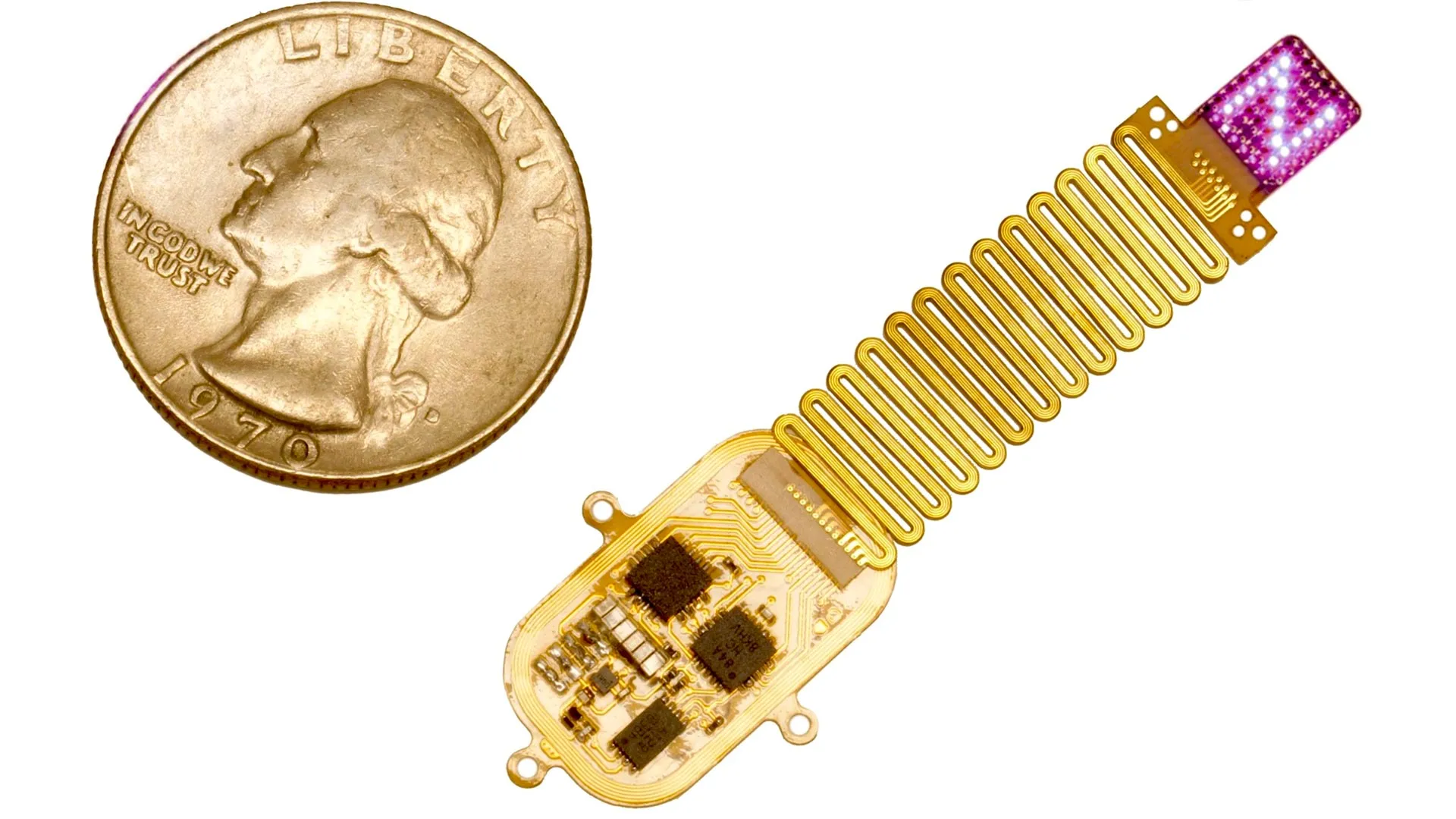
The newly developed device distinguishes itself through its unique design and operational mechanism. Unlike bulky, wired implants that can restrict movement and introduce complications, this system is remarkably soft and flexible. It is engineered to conform gently beneath the scalp, resting directly on the skull, making it minimally invasive.
From its position, the implant projects carefully controlled patterns of light directly through the cranial bone. These light patterns are precisely calibrated to activate specific groups of neurons located within the brain's cortex. A crucial aspect of this technology, known as optogenetics, involves genetically modifying these target neurons to make them responsive to light. When exposed to specific light frequencies, these engineered neurons fire, effectively receiving and processing the delivered information.
This method offers several advantages over traditional electrical stimulation. Light can be delivered with greater precision to activate specific cell types, and its non-invasive application through the skull significantly reduces the risks associated with brain surgery and long-term implantation. The wireless nature further enhances its utility, allowing for seamless integration without external hardware tethering the user.
Unlocking Brain's Interpretive Abilities: Early Findings
During rigorous testing phases, researchers conducted experiments using mouse models to evaluate the device's efficacy. These studies involved delivering tiny, precisely timed bursts of light to stimulate targeted populations of genetically modified neurons deep within the animals' brains. The results were compelling: the mice rapidly learned to interpret these distinct light patterns as meaningful cues, demonstrating their capacity to process and respond to entirely artificial sensory inputs.
Even in the absence of traditional sensory information—such as sound, sight, or touch—the animals successfully utilized the incoming optical data to make informed decisions and accurately complete behavioral tasks. This remarkable ability highlights the brain's inherent plasticity and its capacity to integrate novel forms of information into its existing interpretive frameworks.
Dr. Yevgenia Kozorovitskiy, a Northwestern neurobiologist who spearheaded the experimental component of the study, emphasized the profound implications of this capability. "Our brains are constantly turning electrical activity into experiences, and this technology gives us a way to tap into that process directly," she stated. "This platform lets us create entirely new signals and see how the brain learns to use them. It brings us just a little bit closer to restoring lost senses after injuries or disease while offering a window into the basic principles that allow us to perceive the world."
Her insights underscore the dual benefit of this research: not only does it pave the way for practical medical applications, but it also provides an unprecedented tool for fundamental neuroscience research, allowing scientists to explore the very mechanisms by which the brain constructs reality.
Technological Advancements in Bioelectronics
The development of this sophisticated device required significant innovation in bioelectronics, led by John A. Rogers, a prominent figure in the field. He elaborated on the engineering challenges and breakthroughs involved: "Developing this device required rethinking how to deliver patterned stimulation to the brain in a format that is both minimally invasive and fully implantable."
The solution involved integrating a soft, conformable array of micro-LEDs—each incredibly small, comparable to the thickness of a single strand of human hair—with a wirelessly powered control module. This ingenious design created a system that can be programmed in real time while remaining completely beneath the skin. Crucially, the implant operates without any measurable impact on the natural behaviors of the animals, ensuring ecological validity for research and potential comfort for future human applications.
"It represents a significant step forward in building devices that can interface with the brain without the need for burdensome wires or bulky external hardware," Rogers added. "It's valuable both in the immediate term for basic neuroscience research and in the longer term for addressing health challenges in humans."
From Single Point to Complex Communication
This latest research builds upon earlier pioneering work by the same team. In 2021, they introduced the first fully implantable, programmable, wireless, and battery-free device capable of controlling neurons with light. That initial system utilized a single micro-LED probe to influence social behavior in mice. A key advantage then was its wireless design, which allowed mice to move freely in social environments, unlike traditional optogenetic setups that relied on restrictive fiberoptic wires.
The new device represents a substantial evolution, significantly extending its capabilities for complex communication with the brain. Instead of stimulating a single, localized region, the updated system incorporates an array of up to 64 independently programmable micro-LEDs. Each light source can be controlled in real time, enabling researchers to deliver intricate sequences that closely mimic the distributed activity patterns naturally produced by the brain during sensory experiences. This multi-site approach is vital because real sensations activate broad neural networks, not just isolated neurons, thus mirroring how the cortex typically functions.
Dr. Mingzheng Wu, the study's first author and a postdoctoral researcher, highlighted this advancement: "In the first paper, we used a single micro-LED. Now we're using an array of 64 micro-LEDs to control the pattern of cortical activity. The number of patterns we can generate with various combinations of LEDs—frequency, intensity, and temporal sequence—is nearly infinite."
Despite this enhanced capability, the device maintains an impressively compact form factor. It is roughly the size of a postage stamp and thinner than a credit card. Importantly, this new version eliminates the need for inserting a probe directly into the brain, instead gently conforming to the skull's surface and shining light through the bone. Dr. Kozorovitskiy explained, "Red light penetrates tissues quite well. It reaches deep enough to activate neurons through the skull."
Demonstrating Behavioral Interpretation
To rigorously evaluate the system's ability to convey meaningful information, the research team worked with mice genetically engineered to possess light-responsive neurons within their cortex. The animals underwent training to associate a specific pattern of light stimulation with a reward, typically found at a designated port within a testing chamber.
Across a series of experiments, the implant delivered a predefined pattern across four distinct cortical regions, effectively "tapping" a coded message directly into the brain. The mice successfully learned to identify this target pattern amidst numerous alternative stimuli. Upon detecting the correct artificial signal, they consistently navigated to the appropriate port to receive their reward.
"By consistently selecting the correct port, the animal showed that it received the message," Wu confirmed. "They can't use language to tell us what they sense, so they communicate through their behavior." This behavioral validation provides crucial evidence that the brain can indeed interpret these artificial light signals as actionable information.
Far-Reaching Medical Applications and Future Horizons
The potential medical applications of this neurotechnology are vast and transformative. The device could one day provide crucial sensory feedback for advanced prosthetic limbs, allowing users to "feel" textures or pressure. It also offers a pathway for delivering artificial inputs for future hearing or vision prostheses, potentially restoring these vital senses to individuals who have lost them.
Beyond sensory restoration, the technology could facilitate the precise control of robotic limbs, significantly improving the dexterity and functionality of assistive devices. Furthermore, it holds promise for enhancing rehabilitation efforts after injuries or strokes by directly stimulating neural pathways involved in motor control and cognitive function. The ability to modify pain perception without reliance on medications also represents a significant breakthrough, offering a novel approach to chronic pain management.
Looking ahead, the research team plans to explore more sophisticated patterns of light stimulation and to determine the maximum number of distinct signals the brain can reliably learn and interpret. This ongoing work aims to push the boundaries of brain-computer interface technology, bringing us closer to a future where direct, seamless communication with the brain is not only possible but also commonplace.
The Innovators Behind the Breakthrough
The groundbreaking work was led by a multidisciplinary team of experts at Northwestern University. Dr. Yevgenia Kozorovitskiy, the Irving M. Klotz Professor of Neurobiology in Northwestern's Weinberg College of Arts and Sciences and a member of the Chemistry of Life Processes Institute, directed the experimental efforts. Dr. John A. Rogers, a leading figure in bioelectronics, holds appointments in materials science and engineering, biomedical engineering, and neurological surgery, and directs the Querrey Simpson Institute for Bioelectronics, overseeing the technology's development. Dr. Mingzheng Wu served as the study's first author, contributing significantly to the empirical findings.
This collaboration of neurobiology and engineering expertise highlights the interdisciplinary nature of modern scientific breakthroughs and sets a new benchmark for wireless neural interface technologies.
Related Resources:
❓ Frequently Asked Questions
What is this new wireless brain implant technology?This is a flexible, wireless device developed by Northwestern University scientists that uses precisely controlled light patterns to transmit information directly into the brain. It sits beneath the scalp on the skull and activates genetically modified neurons through the bone, bypassing traditional sensory organs.
How does the wireless brain implant work?The implant contains an array of up to 64 tiny micro-LEDs. These LEDs project specific patterns of red light through the skull to activate neurons that have been genetically engineered to be light-responsive (a technique called optogenetics). This direct light stimulation allows researchers to send coded messages or sensory information straight to the brain's cortex.
What are the potential medical applications of this device?The technology holds vast potential, including providing sensory feedback for prosthetic limbs, serving as artificial inputs for future hearing or vision prostheses, controlling robotic limbs, improving rehabilitation outcomes after injury or stroke, and modifying pain perception without the need for medication.
How does this research differ from previous brain stimulation methods?This new device is unique because it is wireless, fully implantable, and minimally invasive, sitting on the skull rather than requiring probes directly into the brain. It uses a multi-site array of 64 micro-LEDs, allowing for complex, programmable light patterns that more closely mimic natural brain activity, a significant advancement over earlier single-LED or wired optogenetic systems.
This article is an independent analysis and commentary based on publicly available information.
Comments (0)